- The most recent issue to be published was 35(3)
- For further information, please see Publishing/Despatch Schedule
- Database last updated on Mon, 01 Feb 2010 16:10:49 +0000
Contents of Cave & Karst Science 35(3)
This page may take a few seconds to
load. Please wait ...
- Cave and Karst Science (iv + 48pp)
(PDF 6331K)
Download PDF of entire publication
- GUNN, John and David LOWE (eds.). (2008). Cave and Karst Science
35(3).
Buxton: British Cave Research Association.
£6.00 plus postage. ISSN 1356-191X. iv + 48pp, A4, with photos, maps and diagrams.
This issue has a cover date of 2008 (December) and was published in January 2010.
- The transactions of the British Cave Research Association
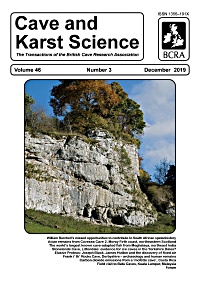
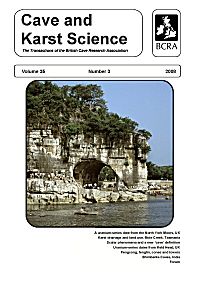
- Front cover photo (page i)
(PDF 246K)

- by Tony WALTHAM.
A splendid piece of phreatic tube at Guilin, China, truncated by the Li River and now isolated in a modest remnant tower. The site is known as Elephant Trunk Hill (Xiangbi Shan) after its passing resemblance to a drinking elephant when seen from the more frequently visited viewpoint on the other side. The cave is a relict of an ancient and undated drainage system that developed before surface lowering intersected it while the karst evolved into the fine fenglin that now surrounds Guilin. Photograph by Tony Waltham.
-
- Notes for Contributors (page ii)
(PDF 109K)

-
- Contents (p73)
(PDF 98K)

-
- Corrigenda to Vol 35(1&2) (p74)
(PDF 131K)

-
- Editorial (p75)
(PDF 96K)

- by Dave LOWE and John GUNN.
-
- Jack Myers leaves BCRA a substantial bequest (p76)
(PDF 93K)

- by David CHECKLEY.
-
- Fengcong, fenglin, cone karst and tower karst (pp77-88)
(PDF 2029K)

- by Tony WALTHAM.
Fengcong and fenglin are the two major types of karst terrain as defined in Chinese literature. They correlate only loosely with the Western terms of cone and tower karst respectively. With its isolated towers rising from a karst plain, fenglin is the most extreme form of karst landscape, and much of it may evolve from fengcong where tectonic uplift is critically slow, but overall it appears to be polygenetic. It is suggested that fengcong and fenglin are more useful karst terms with genetic implications and should take precedence, whereas cones and towers should be used purely as descriptive terms. Classification: Paper. Date: Received 16 March 09; Accepted 19 October 09.
- Bibliograph: WALTHAM, Tony. (2008). Fengcong, fenglin, cone karst and tower karst. Cave and Karst Science 35(3), pp77-88.
-
- Size matters: scalar phenomena and a proposal for an ecological definition of 'cave (pp89-94)
(PDF 970K)

- by Max MOSELEY.
Caves, as ecological units, are redefined in terms of the ecologically-significant scalar phenomena that, in contrast with such traditional criteria as perpetual darkness, environmental stability and oligotrophy, are the special characteristics of large cavities (macrocaverns) in rocks. When so defined, 'caves' are ecologically distinct from the mesocaverns and all other subterranean habitats. Some implications of this perspective for the ecological classification of animals found in subterranean habitats are briefly discussed. Classification: Paper. Date: Received 10 July 09; Accepted 12 September 09. Keywords: caves, scalar phenomena, macrocaverns, mesocaverns, communities, terminology.
- Bibliograph: MOSELEY, Max. (2008). Size matters: scalar phenomena and a proposal for an ecological definition of 'cave. Cave and Karst Science 35(3), pp89-94.
-
- Karst drainage relations with catchment land use change, Mole Creek, Tasmania, Australia (pp95-104)
(PDF 996K)

- by Deborah L HUNTER, Trevor W LEWIS and Joanna ELLISON.
Since 2001, the previously perennial Parsons' Spring of the Mole Creek fluviokarst in northwestern Tasmania, Australia, has become intermittent in discharge. This change follows the establishment of 636 ha of eucalypt plantations since 1995 above the Spring, including where Quaternary slope deposits obscure the geological contact of the limestone with overlying rocks. In this 2008 study, water quality was compared and contrasted between Parsons' Spring and other sites in the study catchment and a resurgence in a nearby reference catchment over different flow conditions and in response to a rainstorm. Results show that the study spring has a mixed recharge regime and complex discharge controls, including diffuse and conduit hydrological components. Parsons' Spring is probably the main wet season overflow spring of a distributary system connected to the phreatic aquifer underlying the area. Apparent chemical 'signatures' indicating soil disturbance in the study spring's waters implied the presence of an epikarst reservoir beneath the slope deposits cultivated for plantation establishment. Given their location, extent and growth stage, the plantations are expected to reduce aquifer recharge substantially by 2013-2018 as interception of recharge increases. The consequent reduction of available aquifer yield would result in economic stress for the rural community and compromise of karst ecosystems. (This paper was first presented audio-visually at a conference of the Australian Speleological Federation in January 2009, and a shorter version has been submitted for the conference proceedings). Classification: Paper. Date: Received 14 January 09; Accepted 20 September 09.
- Bibliograph: HUNTER, Deborah L, Trevor W LEWIS and Joanna ELLISON. (2008). Karst drainage relations with catchment land use change, Mole Creek, Tasmania, Australia. Cave and Karst Science 35(3), pp95-104.
-
- A uranium-series date from a karst cave on the North York Moors, Yorkshire, UK (pp105-106)
(PDF 162K)

- by Phillip J MURPHY and David J LOWE.
Classification: Report. Date: Received 02 September 09; Accepted 08 October 09.
- Bibliograph: MURPHY, Phillip J and David J LOWE. (2008). A uranium-series date from a karst cave on the North York Moors, Yorkshire, UK. Cave and Karst Science 35(3), pp105-106.
-
- Bhimbetka Caves, Madhya Pradesh, India (pp107-110)
(PDF 939K)

- by Tony WALTHAM.
The Bhimbetka Hills in central India are made of Precambrian quartzitic sandstone and contain hundreds of small caves and rock shelters, with origins similar to those of other caves in quartzite. The caves are also notable for their wealth of Palaeolithic and Mesolithic paintings. Classification: Report. Date: Received 25 April 09; Accepted 29 May 09. Keywords: cave, sandstone, paintings, India.
- Bibliograph: WALTHAM, Tony. (2008). Bhimbetka Caves, Madhya Pradesh, India. Cave and Karst Science 35(3), pp107-110.
-
- New uranium-series dates from Keld Head, Kingsdale, North Yorkshire, UK (pp111-114)
(PDF 1020K)

- by Phil MURPHY, John CORDINGLEY and Tony WALTHAM.
Dated stalagmite flowstone from the underwater passages in Keld Head indicates that the cave was partially drained about 89,000 years ago. This implies that the cave was draining into a Kingsdale valley that had a lower floor profile prior to deposition of the Raven Ray moraine and subsequent alluviation of the main valley floor. Classification: Report. Date: Received 09 September 09; Accepted 16 September 09. Keywords: Kingsdale, stalagmite, uranium-series dates, glaciation, alluviation.
- Bibliograph: MURPHY, Phil, John CORDINGLEY and Tony WALTHAM. (2008). New uranium-series dates from Keld Head, Kingsdale, North Yorkshire, UK. Cave and Karst Science 35(3), pp111-114.
-
- Abstracts Of the 20th BCRA Cave Science Symposium, University of Sheffield, 7 March 2009, and Field Meeting, Creswell Crags, 8 March 2009 (pp115-120)
(PDF 174K)

- Classification: Forum.
-
- Book Review (p120)
(PDF 109K)

- Hydromythology and the ancient Greek world, an earth science perspective emphasizing karst hydrology, by Cindy Clendenon. Published by Fineline Science Press, Lansing, Michigan. 2009. xvii + 502 pp. 7 maps. Soft back. ISBN 978-0-9818421-0-3. Price US $ 32.95.
Classification: Forum.
-
- Research Fund and Grants (page iii)
(PDF 101K)

-
- Back cover photos (page iv)
(PDF 453K)

- by Tony WALTHAM.
A montage of images from the splendid karst around Guilin and Yangshuo in Guangxi, China. Photographs by Tony Waltham.
-

Cave and Karst Science (ISSN 1356-191X) is
published three times a year and is issued to members of the
British Cave Research Association who have opted
to receive it. It has been published continuously since BCRA's foundation in
1973; firstly as the Transactions of the British Cave Research Association
(ISSN 0305-859X) then, from 1982 to 1993, as Cave Science (ISSN 0263-760X).
Virtually all issues of Cave Science since vol. 10 (1985) and all issues of
C&KS (vol. 21 onward) are still in print.
Annual Subscriptions are available to non-members.
There is a discount of 50% for undergraduates. For destinations outside the UK,
extra postage is payable. Single issues are available. Online Access to
Cave and Karst Science is free to all BCRA members. Non-members can purchase an
annual subscription or a monthly guest pass. See BCRA
Publications Sales for further information and a link to the Ordering
pages. |

View Contents:
 BCRA is a UK registered charity and is a constituent body
of the British Caving Association,
undertaking charitable activities on behalf of the BCA.
BCRA publishes a range of periodicals and books. For information about
subscriptions, joining BCA / BCRA, or exchanging caving publications with BCRA
please contact our membership office, see Contacts Page.
Purchase Items
Publications Info
For staff use: Link to
Database |