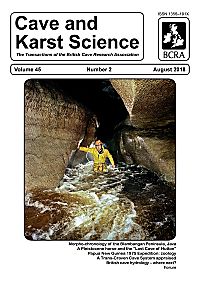
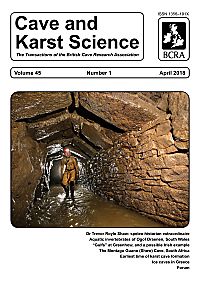
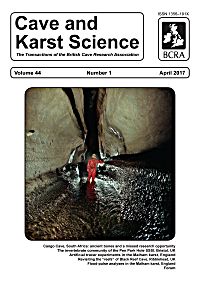
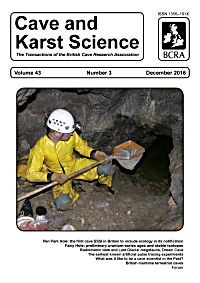
- The most recent issue to be published was 34(2)
- For further information, please see Publishing/Despatch Schedule
- Database last updated on Sat, 13 Dec 2008 17:19:28 +0000
Contents of Cave & Karst Science 34(2)
This page may take a few seconds to
load. Please wait ...
- Cave and Karst Science (iv + 48pp)
(PDF 7105K)
Download PDF of entire publication
- GUNN, John and David LOWE (eds.). (2007). Cave and Karst Science
34(2).
Buxton: British Cave Research Association.
£6.00 plus postage. ISSN 1356-191X. iv + 48pp, A4, with photos, maps and diagrams.
This issue has a cover date of 2007 (September) and was published in October 2008.
- The transactions of the British Cave Research Association
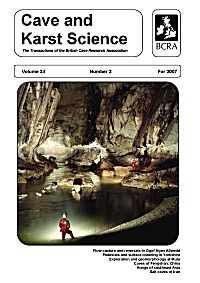
- Front cover photo (page i)
(PDF 86K)

- by Jerry WOOLDRIDGE.
The River Passage in Clearwater Cave, the modern trunk drain out of Gunung Api, in the heart of the fabulous Mulu karst in Sarawak, on the island of Borneo. This splendid river cave typifies the grandeur of the Mulu caves, where 30 years of exploration by British cavers has revealed an unparalleled series of great caves. Photo by Jerry Wooldridge FRPS.
-
- Notes for Contributors (page ii)
(PDF 34K)

-
- Contents (p49)
(PDF 18K)

-
- Editorial (p50)
(PDF 16K)

- by Tony WALTHAM.
-
- The caves of Mulu, Sarawak: their exploration and geomorphology (pp51-60)
(PDF 1413K)

- by Andy FARRANT, Matt KIRBY and Pete SMART.
Thirty years of underground exploration in Mulu has been led by successive teams of predominantly British and American cavers with the very active involvement of many local cavers. More than 325km of cave passages have now been mapped, and this figure continues to rise with major discoveries on every new expedition. With most passages being of large dimensions, Mulu is one of the most cavernous karsts in the world. Cave development was primarily in a succession of strike-orientated conduits whose passage walls are scored by deep notches that relate to aggrading gravel fans of the Melinau and Melinau Paku Rivers. Dating of the caves has allowed estimation of tectonic uplift rates, while isotope studies have revealed valuable palaeoclimate data. Classification: Paper. Date: Received June 08; Accepted July 08. Keywords: cave, notch, gravel terrace, uplift, Mulu, Sarawak.
- Bibliograph: FARRANT, Andy, Matt KIRBY and Pete SMART. (2007). The caves of Mulu, Sarawak: their exploration and geomorphology. Cave and Karst Science 34(2), pp51-60.
-
- Pedestal formation and surface lowering in the Carboniferous Limestone of Norber and Scales Moor, Yorkshire, UK (pp61-68)
(PDF 674K)

- by Brian PARRY.
The formation of Carboniferous limestone pedestals with vertical sidewalls beneath Devensian erratics at Norber, has taken place primarily in a sub-regolith karstic environment; little or no formation occurred prior to c.10,000BP. In contrast, the formation of pedestals with sloping sidewalls on Scales Moor has taken place largely in a subaerial karstic environment; formation of subaerial pedestals commenced at c.14,500BP in England and Wales, and c.13,700BP in Ireland. Measured heights of pedestals indicate that the post-Devensian-deglaciation inter-pedestal Carboniferous limestone surface has been lowered by a mean of about 46cm in a sub-regolith environment and about 15cm in a subaerial environment. Classification: Paper. Date: Submitted April 08; Accepted July 08. Keywords: Keywords: limestone, pedestal, erratic, surface lowering, Norber, Yorkshire, Ireland.
- Bibliograph: PARRY, Brian. (2007). Pedestal formation and surface lowering in the Carboniferous Limestone of Norber and Scales Moor, Yorkshire, UK. Cave and Karst Science 34(2), pp61-68.
-
- Flow capture and reversal in the Agen Allwedd Entrance Series, south Wales: evidence for glacial flooding and impoundment (pp69-76)
(PDF 636K)

- by Michael J SIMMS and John B HUNT.
Detailed observations of passage morphology, scallop orientations, and cross-cutting relationships of vadose notches and roof heights within a small area of the Agen Allwedd cave system, south Wales, reveal a complex history of flow re-routing linked to several successive phreatic-vadose cycles. At least three discrete phases of phreatic development can be recognized, each succeeded by a period of vadose entrenchment. Two distinct episodes of flow diversion are evident and were initiated during separate phreatic phases. The repeated establishment of phreatic conditions at such a high level within the cave system can be attributed either to glacial impoundment of meltwater recharge and/or the creation of a localized perched phreas as a result of temporary blockages. We conclude that glacial meltwater from the Usk valley glacier entered the cave along its northern edge and was impounded as a result of valley glaciers blocking lower outlets, causing flooding of the entire cave system during glaciations. Vadose entrenchment then occurred as much of the cave was drained during ensuing interglacial(s). Drainage rerouting occurred in response to temporary, but prolonged, blockages that allowed meltwater recharge to generate high hydrostatic pressures. Newly opened or exposed fractures in the limestone were thereby exploited, creating bypass routes. This model, which is consistent with what is known of ice depths across the region during the Pleistocene, has significant implications for the evolution of the entire cave system and indeed for other caves in broadly analogous situations in south Wales and beyond. Classification: Paper. Date: Submitted June 08; Accepted July 08. Keywords: Agen Allwedd, passage morphology, scallops, glacial meltwater, flow diversion, Pleistocene.
- Bibliograph: SIMMS, Michael J and John B HUNT. (2007). Flow capture and reversal in the Agen Allwedd Entrance Series, south Wales: evidence for glacial flooding and impoundment. Cave and Karst Science 34(2), pp69-76.
-
- Hongs of southeast Asia (pp77-82)
(PDF 1494K)

- by Liz PRICE and Tony WALTHAM.
Hongs are dolines invaded by the sea within fengcong karst, and are commonly accessible only through caves within the tidal zone. The best of them are in the limestone islands of Phang Nga and Ha Long Bays, in Thailand and Vietnam. Isolated within rugged and forested terrains, hong lagoons can be very beautiful sites. The sea-level caves that lead into them either pre-date the hongs or developed as a result of their presence. Classification: Paper. Date: Submitted April 08; Accepted July 08.
- Bibliograph: PRICE, Liz and Tony WALTHAM. (2007). Hongs of southeast Asia. Cave and Karst Science 34(2), pp77-82.
-
- Caves and karst of Fengshan, China (pp83-90)
(PDF 1273K)

- by Ged CAMPION.
The caves of Fengshan have been explored by three Sino-British expeditions between March 2004 and November 2005. The significance of these explorations was highlighted in 2005 when the Jiangzhou area of Fengshan was given Geopark status. The Jiangzhou cave system has a surveyed length of 38.5km, the second longest cave in China. Many interesting leads still exist in the system, and the possibility of linking Jiangzhou to other caves means that it has considerable potential to be extended in the future. The caves of Fengshan are described, with observations on the development of the karst and the speleogenesis of the Jiangzhou system. The delicate balance between the needs of the population, tourism and conservation is assessed. Classification: Paper. Date: Received June 08; Accepted July 08. Keywords: cave, karst, China, Fengshan, Bama, conservation.
- Bibliograph: CAMPION, Ged. (2007). Caves and karst of Fengshan, China. Cave and Karst Science 34(2), pp83-90.
-
- Karst and caves within the salt domes of Iran (pp91-96)
(PDF 1128K)

- by Tony WALTHAM.
The salt domes of southern Iran are mountains of pure salt kilometres across formed at the outcrop of deep seated salt diapirs. Namakdan and Hormoz are two domes that support some of the most spectacular landscapes of doline karst eroded into the salt. Beneath the surface, caves contain long passages and some large chambers, all decorated with beautiful displays of salt stalactites. Classification: Paper. Date: Received April 08; Accepted July 08. Keywords: salt karst, salt cave, salt stalactite, salt dome, Iran.
- Bibliograph: WALTHAM, Tony. (2007). Karst and caves within the salt domes of Iran. Cave and Karst Science 34(2), pp91-96.
-
- Research Fund and Grants (page iii)
(PDF 23K)

-
- Back cover photos (page iv)
(PDF 368K)

- A montage of images from articles within this issue.
-

Cave and Karst Science (ISSN 1356-191X) is
published three times a year and is issued to members of the
British Cave Research Association who have opted
to receive it. It has been published continuously since BCRA's foundation in
1973; firstly as the Transactions of the British Cave Research Association
(ISSN 0305-859X) then, from 1982 to 1993, as Cave Science (ISSN 0263-760X).
Virtually all issues of Cave Science since vol. 10 (1985) and all issues of
C&KS (vol. 21 onward) are still in print.
Annual Subscriptions are available to non-members.
There is a discount of 50% for undergraduates. For destinations outside the UK,
extra postage is payable. Single issues are available. Online Access to
Cave and Karst Science is free to all BCRA members. Non-members can purchase an
annual subscription or a monthly guest pass. See BCRA
Publications Sales for further information and a link to the Ordering
pages. |

View Contents:
 BCRA is a UK registered charity and is a constituent body
of the British Caving Association,
undertaking charitable activities on behalf of the BCA.
BCRA publishes a range of periodicals and books. For information about
subscriptions, joining BCA / BCRA, or exchanging caving publications with BCRA
please contact our membership office, see Contacts Page.
Search Database
Purchase Items
Publications Info
For staff use: Link to
Database |