Cave and Karst Science Logo

Volume 31(3), 2004

BCRA > Publications > Cave & Karst Science> Contents

Scroll down for Editorial | Papers | Reports | Forum | Thesis Abstracts

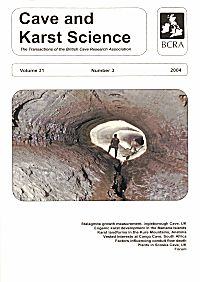
Front cover
  • Stalagmite growth measurement, Ingleborough Cave, UK
  • Eogenic karst development in the Mariana Islands
  • Karst landforms in the Kure Mountains, Anatolia
  • Vested interests at Cango Cave, South Africa
  • Factors influencing conduit flow depth
  • Plants in Scoska Cave, UK
  • Forum

Cover photo by Tony Waltham
The Subway in Castleguard Cave, in the Canadian Rocky Mountains, is a splendid phreatic tube, almost dead straight for over 500 metres. It is formed along a bed-joint intersection in the gently dipping limestone. As part of a recognisable and descending phreatic trunk passage many kilometres long, this tube must have developed at a depth of some hundreds of metres below its contemporary water table (see the paper by Steve Worthington in this Issue).

Editorial

(Gunn, J. & D. Lowe)
Editorial
Vol 31 (3) p 99
After an unusually long but completely unavoidable delay, we are pleased at last to be writing the Editorial to this final issue of Cave and Karst Science, Volume 31. A steady supply of fresh material is the lifeblood of any journal, and during the past nine months or so there has been an unprecedented dearth of submissions. Even now, with enough material accumulated to provide a viable and interesting issue, the famine continues. Despite the long delay, our hope is that there will be something to interest all our readers in this issue. Steve Worthington presents aspects of geology and hydrology, different facets of geomorphology are discussed by Ali Uzun and by Tim Stafford et al., with cave ecology from Allan Pentecost and Zhaohui Zhang, historical science and modern dating techniques from Don McFarlane et al., and cave history from Steve Craven. There is also a wide geographical coverage, encompassing the Mariana Islands, South Africa and Turkey as well as the Yorkshire Dales.
Sadly (from our viewpoint) this is likely to be the last Volume of Cave and Karst Science in the form that it has taken since 1994 when we took over as editors. Establishment of the British Caving Association (BCA) has introduced many positive benefits for British cavers but on the negative side there has been a dramatic fall in membership of the British Cave Research Association (BCRA), and hence in subscribers to this journal. As editors we have no direct involvement in financial matters but we understand that it will no longer be economical to produce printed copies of the journal. Current plans are that a small number of copies of the journal will be printed for libraries and for those members or subscribers who are prepared to pay a premium. Other members will receive the journal on CD, or possibly via the World Wide Web. Ultimately this is a decision for BCRA Council. Anyone with strong views should attend the Annual General Meeting and/or contact the BCRA Secretary and Chairman.
Production issues notwithstanding, our aim as editors is to continue to produce a leading scientific journal, with international content and appeal, for cave and karst scientists, whilst also providing a forum for British cavers to publish shorter works that may be of interest more to the local audience than to the international readership. To achieve this we need a steady stream of material and would again urge all British cavers who have an interest in scientific matters to send us their results and ideas, in the form of reports or short papers. As professional scientists as well as being editors of the journal, we remain committed to supporting cave science in Britain. Hence, we are strongly in favour of a suggestion that the BCRA should provide a series of annual undergraduate bursaries that would provide financial assistance for cave-related dissertations. One condition of these bursaries should be that the abstract be sent for publication in Cave and Karst Science. Ideally each award recipient should also write a brief report (or a full paper if they feel able). An example of what can be produced from an undergraduate dissertation can be found in Transactions of the British Cave Research Association, Vol.1(3), 1974, pp 159-164, a submission that helped to launch the career of one of the editors! As is customary in the final issue we thank all the reviewers who have helped us to evaluate and improve the papers submitted to this Volume: Marcus Buck, Ian Fairchild, Dave Gillieson, Rhian Hicks, Chris Hunt, Alexander Klimchouk, Allan Pentecost, Trevor Shaw, France Sustersic, Tony Vann, Tony Waltham and Paul Wood.
Also, on the technical side, we once again thank our Desk Top Publishing associate, Rebecca Talbot, for somehow still managing to find the time to cope with this demanding task while at the same time dealing with the greater responsibilities and vastly increased work load of her new career track. We also express our gratitude to Steve Summers, Sales Director of the Sherwood Press, for his patience and, especially, for the individual attention and expert knowledge that he dedicates to our specific requirements and to providing a highly efficient interface between his colleagues and ourselves.

Papers

(Kevin STAFFORD, John MYLROIE, Danko TABOROSI and John JENSON)
Eogenetic karst development on a small, tectonically active, carbonate island: Aguijan, Mariana Islands.
Vol 31 (3) pp 101 - 108
Abstract: Aguijan is a small carbonate island in the western Pacific Ocean on the tectonically active Mariana Arc. Eogenetic karst on Aguijan includes epikarst and caves that are controlled by the interaction of fresh and saline waters and brittle deformation. Epikarst proximal to coastlines (littoral eogenetic karren) exhibits jagged, irregular surfaces, while inland karren is more subdued, with metre-scale canyons present in highly fractured regions. Caves occupy two morphologically distinct classes, mixing zone and fissure caves, with different primary controls on dissolution, freshwater lens position, and structural features respectively. Mixing zone caves occupy distinct horizons reflecting previous freshwater lens positions. The decay of organic material trapped at density horizons and the mixing of fresh and saline groundwater at the margins of the lens produces mixing zone caves with globular chambers that are commonly interconnected. Fissure caves are linear caves that develop along planes of structural weakness associated with faults, margin failures and associated tension-release structures (i.e. joints). Although caves are primarily controlled by either mixing zone dissolution or brittle failure, specific sites show contributions of both controls on dissolution.
Horizons of karst development associated with island terrace levels suggest at least three previous sea-level stillstands. The absence of exposed non-carbonate (volcanic) rocks places Aguijan within the Simple Carbonate Island category for island karst development. However, island geomorphology and elevation suggest subsurface non-carbonate rocks modify freshwater lens morphology, which would place Aguijan within the Carbonate Cover Island category. Aguijan demonstrates the utility of the Carbonate Island Karst Model for describing and explaining caves and karst features found on small islands, although Aguijan's Liyang Atkiya, a cave of complex morphology that does not fit current models for island karst, suggests that more work is needed to understand fully the complex hydrology of small, tectonically active, carbonate islands.
(Ali UZUN)
Koru Polje and karst landform evolution in the middle part of the Kure Mountains, Northern Anatolia, Turkey.
Vol 31 (3) pp 109 - 112
Abstract: Koru Polje and its close surroundings lie at an elevation of about 1450 to 2000m in the middle part of the Kure Mountains (the western part of the Northern Anatolia Orogenic Belt). Various karst landforms characteristic of the temperate climatic zone can be seen in this area, which is generally rainy throughout the year, with an annual precipitation of more than 1600mm, cool winter and mild summer temperatures, and an average annual temperature below 7 degrees C. The study area is entirely within the forest zone and its karstic landforms are developed under soil and plant cover. Large closed depressions like Koru Polje and the Subatanyaylasi Depression are shaped by fluviokarstic processes. Quaternary climate changes affected the evolution of large karstic landforms in the study area. Periglacial conditions prevailed during Quaternary cold periods and development of surface karst landforms was interrupted at these times. In warm periods after the release of permafrost, surface water sank into reactivated swallow holes. Thus, karst landform evolution in the study area accelerated during the warmer periods of the Quaternary, and during recent times.
(Donald A McFARLANE, Joyce LUNDBERG and John CORDINGLEY)
A brief history of stalagmite growth measurements at Ingleborough Cave, Yorkshire, United Kingdom.
Vol 31 (3) pp 113 - 118
Abstract: Early (pre-radiometric-dating) measures of growth rates of the Jockey Cap stalagmite, Ingleborough Cave, Yorkshire have been augmented by recent laser range-finder measurements. This yields a growth rate of 0.147mm/yr. Propagation of this rate yields a basal date of 4469 yr BP. C-l 4 dating gives a basal age (after correction for dead carbon content and carbon flux) of 3477-3794 yr BP and a growth rate of 0.18mm/yr, comparing reasonably well with the historical estimates. This date for speleothem initiation correlates with several indices of environmental change in the region: a change to colder, wetter conditions and the beginning of significant forest clearance. U-Th data indicate a change in the type of detrital material introduced to the cave that may correlate with increased agricultural activity at the order of 1350 yr BP.
(Allan PENTECOST and ZHANG Zhaohui)
A note on the distribution of plants in Scoska Cave, North Yorkshire, United Kingdom, and their relationship to light intensity
Vol 31 (3) pp 119 - 122
Abstract: The flora of a small limestone cave was investigated. A total of 59 species was recorded (4 algae, 3 lichens, 47 bryophytes, 4 ferns and 1 angiosperm) making it bryologically the richest cave in Britain and one of the richest in Europe. All but nine of the species had been recorded from other European caves. Species-richness declined irregularly from the entrance (relative irradiance with respect to open sky 12%) to 34m depth (rel. irradiance 0.004%). Bryophytes were found at 0 to 16m depth, where relative irradiance declined to 0.2%. Only algae were encountered at 34m depth. Whereas irradiance, which declined exponentially, was the major factor controlling plant distribution, substratum characteristics and surface moisture were also important.
(Stephen R H WORTH1NGTON)
Hydraulic and geological factors influencing conduit flow depth.
Vol 31 (3) pp 123 - 134
Abstract: There has much been speculation as to whether cave formation should occur at, above, or below the water table, but a satisfactory explanation has been lacking until recently. The last 50 years has seen extensive mapping of caves both above and, more recently, below the water table. It is now becoming apparent that there are systematic differences in depth of flow between different areas and that conduit flow to depths >100m below the water table is not uncommon. Such deep flow is facilitated by the lower viscosity of geothermally heated water at depth. Analysis of data from caves shows that depth of flow is primarily a function of flow path length, stratal dip and fracture anisotropy. This explains why conduits form at shallow depths in platform settings such as in Kentucky, at moderate depths (10-l00m) in folded strata such as in England and in the Appalachian Mountains, and at depths of several hundred metres in exceptional settings where there are very long flow paths.

Reports

(Stephen A CRAVEN)
Vested interests at Cango Cave, South Africa, in the Nineteenth Century.
Vol 31 (3) pp 135 - 137
Abstract: Various vested Nineteenth Century interests are described, relating to the profitable and State owned Cango Cave, viz. the local Field Cornet, the civil service, the surrounding landowner and other adjacent farmers, and the Oudtshoorn Divisional Council. Although it is the stated policy of successive political masters of the Cape Colony that the Cave is a national asset that shall be conserved, the management structure was not conducive to the enforcement of that policy.

Forum


Book Reviews

(Finlayson, B. & E. Hamilton-Smith (eds))
Beneath the surface: A natural history of Australian caves
Published by University of New South Wales Press, Sydney, 2003
ISBN 0 86840 595 7. 182 + xviii pp. A$49.95
Vol 31 (3) pp 139 - 140
(Calaforra, J.M., with photographs by Les, J.)
The gypsum karst of Sorbas: A subterranean journey through the interior of the gypsum
Published by Publicaciones Calle Mayor S L, 2003
86 pp. "For free distribution"
Vol 31 (3) p 140
(Culver, D.C. & W.B. White (eds))
Encyclopedia of caves
Published by Elsevier Academic (Amsterdam, Boston & London), 2005
ISBN 0 12 406061 7. 654 pp. £65
Vol. 31(3) pp 140 - 141
(Prous, A., E. Rubbioli, C. Chabert, L. Piló, A. Brina & L. Horta)
Atlas do Janelao
(Au Pré de Madame Carle, France), 2003
ISBN 2 912402 07 7. 55 pp. £120
Vol. 31(3) p 141
(Waltham, A.C., F. Bell & M. Culshaw)
Sinkholes and subsidence: Karst and cavernous rocks in engineering and construction
Springer Verlag, Berlin, Heidelberg & New York, and Praxis Publishing Ltd, Chichester [Springer-Praxis books in geophysical sciences]
ISBN 3 540 20725 2. £100
Vol. 31(3) pp 142 - 143

Abstracts

Dissertation Abstract
(Meehan, K.)
Effects of exposure to continuous low doses of ionising radiation
Doctor Technologiae, Cape Technikon (now Cape Peninsula University of Technology), January 2005
Vol 31 (3) p 144


This page created by Dr John D. Wilcock


button Top of Page
