
Cave and Karst Science Logo

Volume 28(3), December 2001

BCRA > Publications > Cave & Karst Science> Contents

Scroll down for Editorial | Papers | Reports | Forum | Thesis Abstracts
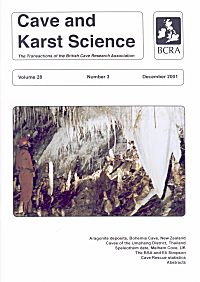
Front cover
  • Aragonite deposits, Bohemia Cave, New Zealand
  • Caves of the Umphang District, Thailand
  • Speleothem date, Malham Cove, UK
  • The BSA and Eli Simpson
  • Cave Rescue statistics
  • Abstracts

Cover photo by Radko Tásler of a large massive aragonite stalactite at the Alberice Corner of the DAC in Bohemia Cave, New Zealand (see article by Tásler et al. in this issue)

Editorial

(Gunn, J. & D. Lowe (eds))
Editorial
Vol 28 (3) p 98

The Cave and Karst Science Editorial was an innovation that was introduced in 1994, when the present team of Editors took over from Trevor Ford. Over the years some of the the editorials have provoked correspondence, debate or the occasional word of congratulation or rebuke at a meeting. However, the overall impression is that the Editorial has not attracted universal applause, nor has it provoked universal apathy. The Editorial is the last part of the journal to be written, and in this issue no dominant theme seems to have emerged, so that there are no targeted editorial comments. The Editors welcome any suggestions as to whether or not this is a good thing, in order to help them to decide whether or not to continue producing editorials in future issues.

Jean Reeve has stood down as Desk Top Publishing Assistant. She is thanked for the workload she carried, the standard that she achieved, and for her good humour during her seven years on the team. Becky Talbot has taken over the DTP rôle, and she is congratulated that she has come to terms quickly with the format and esoteric content of the journal, and the idiosyncratic working practices and publishing requirements of the Editors.

The following reviewers/referees are thanked:


Papers

(Craven, S.A.)
The British Speleological Association (1935 - 1973)
and its founder Eli Simpson:
with particular reference to activities in the northern Pennines of England

Vol 28 (3) pp 99 - 112
Abstract: An account is given of the origins and early history of the British Speleological Association, which can be traced back to Eli Simpson's first cave visit in 1901. The formal founding occurred in 1935, following which, despite its name implying a national organization, it never achieved national status with universal support. Its heyday was from 1939 to 1945, when the activities of other northern clubs went into abeyance. Thereafter it declined rapidly, losing members to new and established clubs, and it eventually merged with the Cave Research Group of Great Britain in 1973 to form the British Cave Research Association.
(Tásler, R., V. Cílek & H. Hercman)
Speleothem decoration of giant domes in Bohemia Cave (New Zealand)
Vol 28 (3) pp 113 - 120
Abstract: Giant domes in Bohemia Cave contain a vast nuber of speleothem formations, 90% of which comprise aragonite, with hydromagnesite accumulations and coatings. The aragonite formations are very young, ranging between -2390 and -2250 years, according to U-Th series analyses. Aragonite appears in typical gravitational forms as well as in complex eccentric shapes. Calcite, microscopic dolomite, opal, Fe and Mn hydroxides, gypsum and sepiolite are all present in small amounts. The greatest concentrations of formation occur on and in the vicinity of the contact between underlying weakly weathered shales (phyllites) and overlying marbles. Bohemia Cave probably contains the largest known accumulation of cave aragonite in the world.
(Ellis, M., S. King & D. Barrett)
Field observations from some caves in the Umphang District, Tak Province, Thailand
Vol 28 (3) pp 121 - 130
Abstract: Basic scientific observations, including measurements of air and water temperature, oxygen and radon concentrations, from caves in a scientifically poorly known karst area in Umphang District, Western Thailand, are described. The results, which illustrate what can be achieved by a small expedition of non-specialist cavers, provide the first evidence of low oxygen and radon concentrations in Thai caves. The results are discussed in the context of published data from other Thai caves. Cave surveys are also presented.

Reports

(Forder, J.)
An analysis of cave rescue statistics, Dales area, UK, 1935 to 2000
Vol 28 (3) pp 131 - 134
Abstract: Data from incidents attended by the Settle-Ingleton Cave Rescue Organisation between 1935 (when it was founded) and 2000 have been analysed according to type, location and frequency. Many accidents occurred in bad weather, and it seems likely that bad weather played a significant rôle in many incidents. It appears that many underground accidents could have been avoidable, e.g. by a better appreciation of how quickly and dramatically caves can respond to rainfall, or by use of a lifeline on all pitches where a ladder is in use, however short.
(Murphy, P.J. & A.G. Latham)
A uranium series date from Malham Cove Rising, North Yorkshire, UK
Vol 28(3) pp 135 - 136
Abstract: Divers noted speleothems underwater at a depth of 2.4m , between 8m and 20m from the Flood Rising entrance of Malham Cove. A sample of speleothem material from a stalagmite curtain 9m inside the cave at a depth of 1.7m was removed and assayed by uranium series disequilibrium alpha counting methods, yielding an uncorrected age of 35,600 +3600/-3500 years BP. If correction is made for the small amount of detrital thorium, then the age shifts to 27,300 +/- 5600 years BP. Thus the overdeepening of the glaciated trough downstream of Malham Cove must pre-date the Mid Devensian (50 - 26ka) warm stage, and be a product of an Early Devensian or older glaciation. This suggests that although the glacial step of the Cove existed in some form prior to the last glacial maximum there were no substantial deposits at the base of the Cove before 27ka. This research was supported by a grant from the BCRA Research Fund. The authors thank John Cordingley for bringing the occurrence of speleothems in Malham Cove Risings to their attention. The Natural Environment Research Council (NERC) is thanked for providing the resources to set up the U-series laboratory in the Department of Archaeology at Liverpool University.

Forum

Abstracts from Karstologia for 1999, 2000 and 2001
Vol 28 (3) pp 137 - 142
Abstracts: BCRA Cave Science Symposium,
School of Earth Sciences,
University of Leeds, Leeds, UK
March 2002

Vol 28 (3) pp 142 - 144

This page created by Dr John D. Wilcock, and edited by David Gibson.


button Top of Page